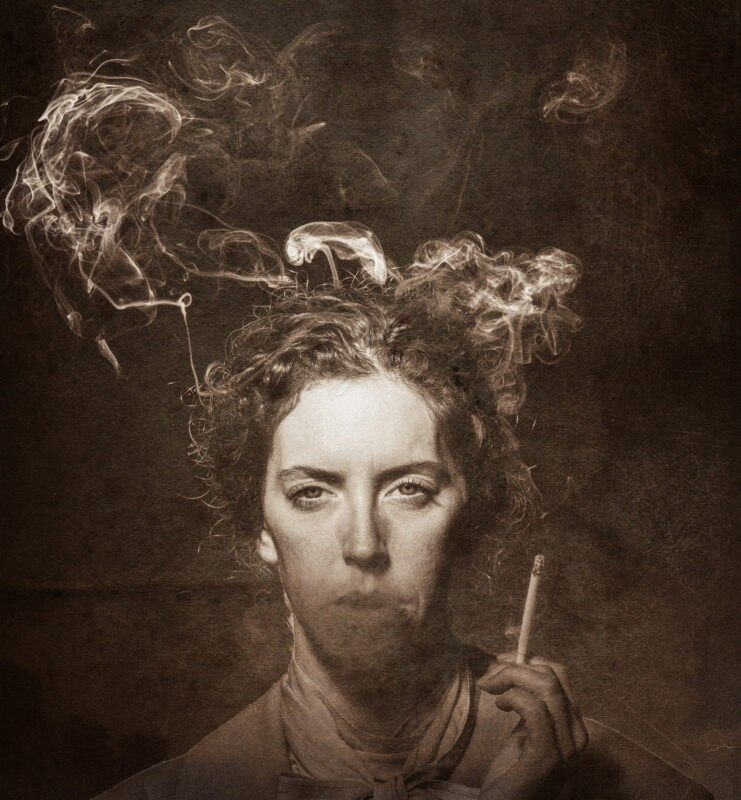
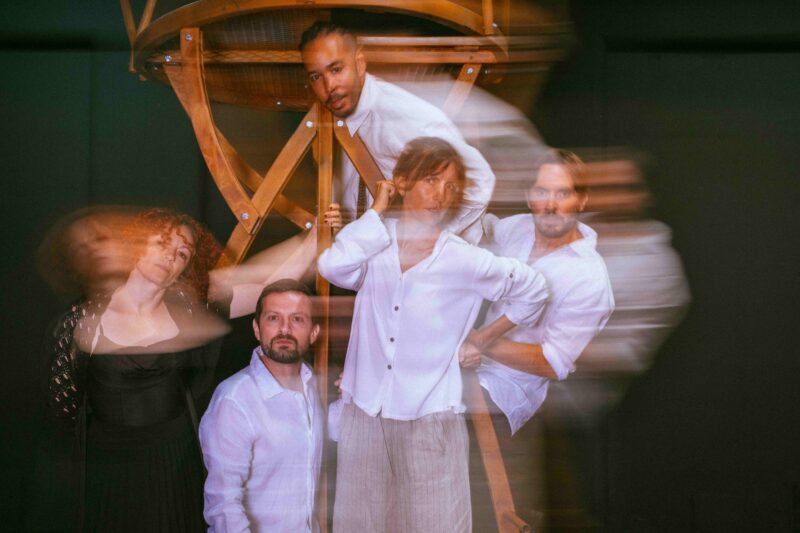
PARA UMA BREVE HISTÓRIA DO FOGO (For a brief history of fire) is the second show of Teatro Praga dedicated to the history of the elements, where each of them is narrator and protagonist and where human beings appear only as guests.
Two stones of Flint or pyrite. The friction of two woods until you see it emerge domesticated, generating light and heat. Oxidation of combustible material. Gases at high temperatures emitting electromagnetic radiation … the history of fire is confused with the history of the universe, from the moment when, thirteen point eight billion years ago, all the dense matter that existed was concentrated, at high temperatures, and the famous Big Bang started the countdown of an expansion that will have as its ultimate end total darkness, without hydrogen or stars that illuminate or heat the planets. In between, the human will to stare at the sun and control fire so as to endure glacial winters, ward off predators or cook them at a campfire or burn Joan of Arc, blow up cities, play with flamethrowers. In the story of the young teenager who put too much oil in the pan for some patties, the protagonist of this show is the explosion that destroyed the kitchen. In the story of the very dear, very small, very frightened boy who took shelter under a leafy pine tree with a calf on his lap, the protagonist is the thunderbolt. And in the story of the God who steals from other gods to give a gift to humans, or in the theater that burns from thread to wick, the protagonist is fire. PARA UMA BREVE HISTÓRIA DO FOGO (For a brief history of fire) doesn’t want to hurt anyone, doesn’t want to tame fire or use it as a weapon, but it does want to look at it, and at its unpredictability, and live like it. Without the ambition of Icarus, we seek an intimacy without closeness, an occupation of explosion, burn or smoke. This will be a spectacle with a lot of heat and that is imagined in the center of the Earth and the spark without ever extinguishing.
In an era in which environmental issues are increasingly important and in which the planet is at risk, Teatro Praga dedicates its attention to each of its five elements, following an outdated but still active theory, to study its past and present, in a cycle that we have designated for a brief history of the elements. Diverting the discussion about the measures to be taken or the responses to be proposed, these shows converse with the elements, looking for a fictional approach more available to listen than to affirm.
Partner