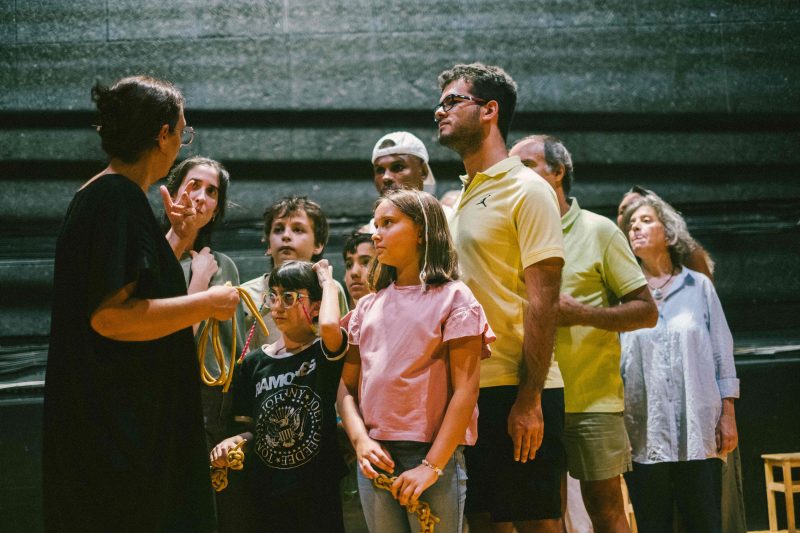
Podia Ser na Tate Mas É Aqui (It Could Be at the Tate But It’s Here) is a series of conversations with artists at Teatro São Luiz. Building on his work on the history of theatre, André e. Teodósio invites two opposing artists to discuss their work, influences, concerns, the dialogue they establish with their peers and their relationship with the country and audiences, as well as the things they dislike. The entry to these meetings is free and they intend to record, in the first person, the flow of thought throughout artists’ histories, sparking discussion around what is seen and felt, inviting everyone to join a qualified and unrestrained conversation. This local gathering will be an incredible opportunity to exchange ideas and collect autographs!
Because it could be at the Tate, but it’s more accessible here.
13 January
Guests: Filipe La Féria and Tiago Vieira
Filipe La Féria and Tiago Vieira, two leading directors from two different generations, are the guests for this first session. Both have their own space, where they have sought to develop their own aesthetic. Teatro Politeama and Latoaria are synonymous with and guarantee unique experiences. But their journeys began long before that. That is where they will start before reaching their destination.
23 February
Guests: Mónica Calle and Ricardo Pais
Mónica Calle and Ricardo Pais are two fearless directors. In this meeting with the director and former director of the São João National Theatre and the director and director of Casa Conveniente, we will understand how the dimensions of theatre, music and dance, or non-normative types of scenic writing, have always been seen as challenges, placing them at the heart of the contemporary map.
27 April 2026
Guests: Alice Azevedo and João Brites
Alice Azevedo and João Brites have careers that are not limited to training as actors and actresses. The uniqueness of their perspectives is affirmed in their use of other artistic languages, from the visual arts to literature, which they integrate into their theatrical work. Furthermore, both the tradition of the work developed by Teatro O Bando and Alice Azevedo’s most recent show share a significant trait: the use of the novel as material for theatrical creation. Between affinities and contrasts, a territory of dialogue emerges, which we will have the opportunity to explore at the beginning of the second quarter of this cycle.
25 May 2026
Guests: Zia Soares and António Pires
Zia Soares and António Pires are two renowned directors who have made their mark in recent decades, something unusual in the context of this cycle. Even so, their practices follow distinct yet complementary paths, opening up new dimensions in the theatrical landscape as their voices have become more established. Both were part of different collectives and artistic experiences before establishing their own paths and unique signatures. Two fundamental paths in the configuration of contemporary theatre, which have broadened the understanding of cultural reality, placing them at the centre of the artistic debate of our time.
POSTPONED TO A DATE TO BE ANNOUNCED
8 June 2026
Guests: João Mota and Joana Craveiro
João Mota was André e. Teodósio’s teacher. Like him, Joana Craveiro was his student. Although with very different premises and formulations, the paths of Comuna Teatro de Pesquisa and Teatro do Vestido, as well as their artistic projects, have always been politically engaged. Their body of work reflects a demand for the restoration of ethics in an aesthetic practice where it so often seems to be absent – in theatre.
29 June 2026
Guests: Maria do Céu Guerra and Teresa Coutinho
This series of conversations began with two men, so it made sense to end it with two women. And two women who cannot be ignored! Maria do Céu Guerra and Teresa Coutinho, unique directors and actresses in the history of theatre in Portugal, share, beyond theatre, an essential link: poetry — as a literary form and as a metaphor for their artistic practice. Both have published literary works and find in theatre a space of freedom and active participation in the construction of a world to come. In their careers, poetry is not just words: it is body, it is memory, and their lived and shared stories.