September 2025 will mark a decade since Estelle Valente began her work at Teatro São Luiz. What started intuitively has evolved into a continuous and profound relationship with the space, the artists, and the stories built here.
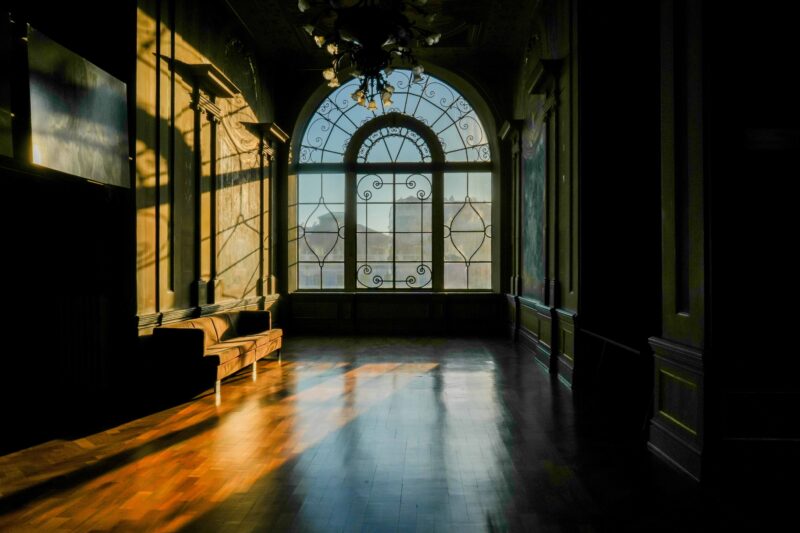
The exhibition presents a visual journey through ten years of photographic presence at the theatre: images of performances, backstage glimpses, portraits and moments of silence captured in the emptiness of corridors and stages.
More than a retrospective, it is a celebration of the complicity between photography and theatre — two ways of seeing, of freezing time and creating memory.
It is also a sensitive testimony of the inner life of São Luiz and its role as a place of creation and gathering.
For ten years, I returned to the São Luiz Theatre with the same intention: to observe.
What is presented here is not an exhaustive archive, nor an inventory of the programme.
It is an edition.
A selection of images that have stood the test of time and remained alive in my eyes.
The exhibition is organised into three parts.
The first is on the street.
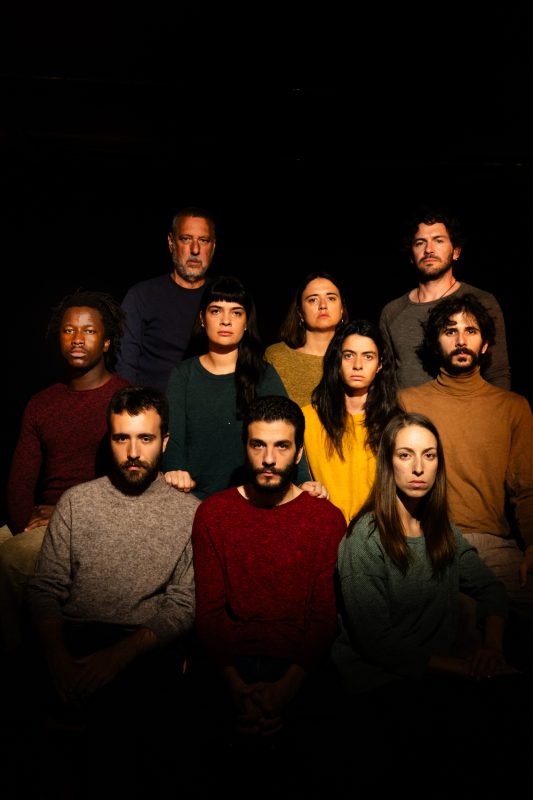
On the wall opposite the theatre, black and white portraits – all taken in the same window – form a collective body. They are artists, technicians, creators and workers who made and make São Luiz. By being displayed outdoors, these faces become part of the city. The repetition of the place and the light transformed the portrait into a continuous, almost ritualistic gesture. The same window, the same light, different presences. A human archive open to all.
The second part occupies the theatre’s public circulation spaces.
Staircases, balconies, foyers and corridors host photographs of scenes, concerts, images taken for São Luiz magazine and fragments of the building itself. Here, the exhibition follows the movement of the public. Theatre, dance and music intersect without hierarchy. What matters is not the event, but the intensity of the moment – the stage lighting, the body in action, the vibration suspended in the air.
The third part is almost secret.
Accessible only through guided tours, it reveals areas that are usually invisible: backstage, under the stage, projection booth, technical corridors. It is not about explaining the theatre, but about allowing it to be discovered from the inside. The wait before going on stage, the silent machinery, the empty space after the show. The theatre as construction, breath and collective work.
These three layers – exterior, public circulation and technical areas – compose a fragmented and intimate portrait. They do not seek to represent everything that happened, but rather to condense an experience: that of accompanying a theatre over time.
Between natural light and stage lighting, presence and structure, visible and invisible, this set of photographs constructs an inevitably subjective view of São Luiz.
A Luz que Ficou (The Light that Remained) is what remains after each round of applause.
The memory that is deposited in faces, spaces and gestures.
It is an attempt to capture, in images, what is by nature ephemeral.
And perhaps that is also what it is: the light that remained in me.
Estelle Valente
22 May – postponed to 5 June
In the Same Light
Portrait Session with Estelle Valente
As part of the exhibition The Light That Remained by photographer Estelle Valente, the public is invited to take part in a unique and free photographic experience on 22 May, the date on which São Luiz Municipal Theatre celebrates its anniversary.
25 June
Stage Photography Workshop
By Estelle Valente
São Luiz invites the public to discover a little about the world of stage photography with photographer Estelle Valente.
BIOGRAPHY
Estelle Valente was born in France, a country with which she maintains a deep connection, and chose Lisbon as her home 15 years ago — a city whose sunshine she cannot do without.
In 2012, she began her collaboration with fado singer Gisela João, which continues to this day. Between 2015 and 2024, she was the official photographer for the São Luiz Municipal Theatre, where she photographed rehearsals, shows and communication campaigns.
Stage photography is the central focus of her work. She continues to collaborate with theatre companies and, this season, is the official photographer for the Variedades Theatre. She also works in the areas of portraiture and concert photography.
The year 2018 marked a turning point in her career: she held her first exhibition, Carla no Papel, in Setúbal, where actress Carla Maciel embodied great divas of 20th-century cinema, such as Marilyn Monroe, Greta Garbo, and Marlene Dietrich. In the same year, she presented the exhibition Le Regard d’Estelle in Paris, followed by an artistic residency at Espace Cardin. To mark the 20th anniversary of José Saramago’s Nobel Prize, she was invited by Anabela Mota Ribeiro to illustrate the book Por Saramago with her photographs.
Between 2019 and 2020, she collaborated with GQ Portugal, where she took portraits of cultural figures. She taught photography at Academia Gerador for four years.
The year 2025 also marks ten years dedicated to theatre and dance photography. The celebrations began with the exhibition L’Art en Scène, at MIMO — Museu da Imagem em Movimento de Leiria (Leiria Museum of the Moving Image), open from September 2025 to January 2026, and will culminate with an exhibition at the place where it all began, the São Luiz Theatre, starting in March 2026.
Her work always seeks to add poetry to the image. She likes to photograph what does not exist.